



Taj Mahal Quartzite Slab: Living Room & Feature Wall Ideas That Age Well
2026-09-15 15:38There are stones that shout, and stones that hold the room. A Taj Mahal Quartzite Slab belongs in the second camp: warm ivory ground, threads of gold and taupe, movement that reads soft instead of loud. In a Taj Mahal Quartzite Living Room it does the work of sculpture — no busy wallpaper required. This guide covers the applications that earn their keep: the Taj Mahal Quartzite Feature Wall, the TV wall, the fireplace surround — plus finishes, pairings, and buying tips.
Why a Taj Mahal Quartzite Slab Belongs in the Living Room
Three reasons, all practical.
Warm neutrals are the decade's story. Design moved on from cool grey, from Milan to Melbourne to Dubai. The rooms winning attention run on warm whites, cream, and low-contrast layering — quiet luxury. Taj Mahal sits at the center of that shift, flattering wood, brass, and linen instead of competing with them.
Marble's looks, without marble's fears. Taj Mahal is not marble. It's a natural quartzite from Brazil — sandstone transformed under immense heat and pressure. At 6.5–7 on the Mohs scale, it's roughly double the hardness of marble (3–4). True quartzite won't etch when lemon or red wine sits too long, and it handles heat far better than marble.
Big slabs beat big seams. On a wall, seams are the enemy. A full slab in large format means one continuous surface; the vein pattern flows as intended and the room reads calmer. Use 20mm (2cm) for walls and counters, 30mm (3cm) for floors and heavy-traffic spaces.
Taj Mahal Quartzite Feature Wall: The Focal Point That Doesn't Shout
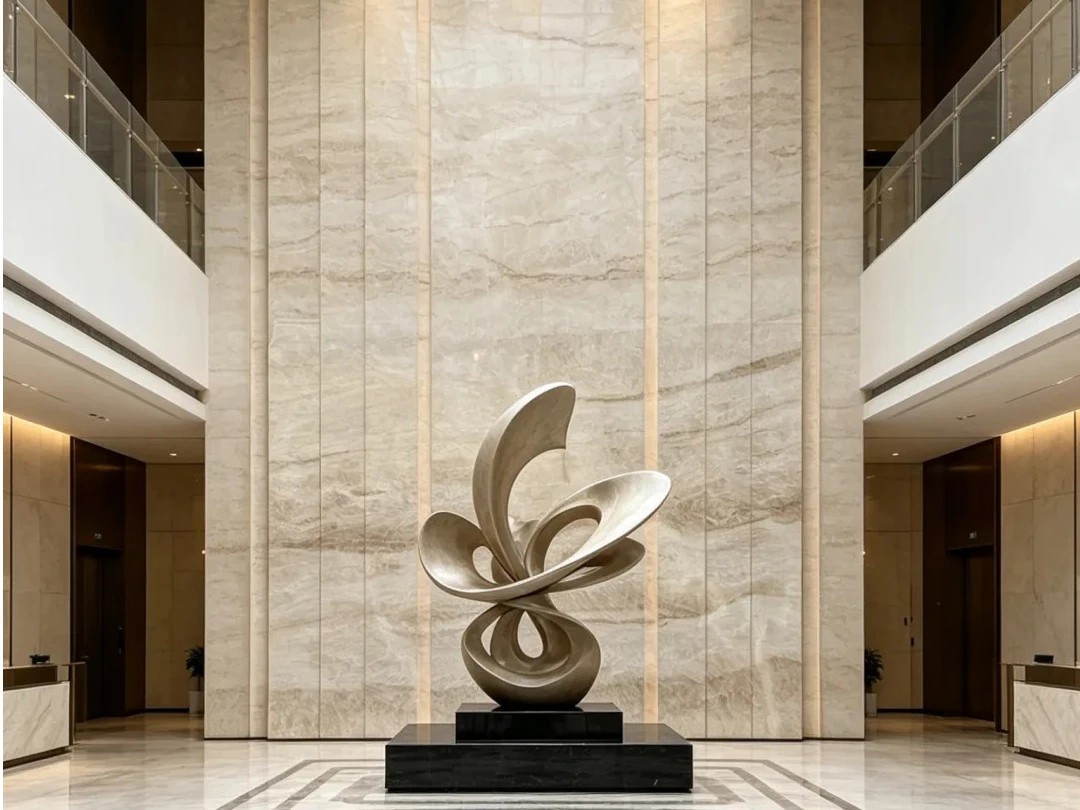
A feature wall should anchor the room, not argue with it. Where a dramatic Patagonia or Blue Roma slab announces itself, a Taj Mahal Quartzite Feature Wall signals quality quietly — the room feels expensive without you being able to say why. That's why it keeps appearing in villas, hotel lobbies, and reception walls worldwide.
Bookmatched pairs are the strongest move. Two slabs from the same block, opened like a book, mirror the veining across the center seam. Buy the pair from the same bundle, view both slabs standing upright before you commit, and plan the vein layout with the fabricator before cutting. Samples lie; slabs tell the truth.
Go full-height or backlit. Floor-to-ceiling cladding creates a backdrop that changes with the light all day; a half-wall gives most of the effect for less. Backlit with warm LEDs (2700K–3000K), the thinner slabs glow softly from within — museum light, not neon. Keep the rest of the room plain; the stone should be the only pattern.
Taj Mahal Quartzite TV Wall: Ideas That Actually Work
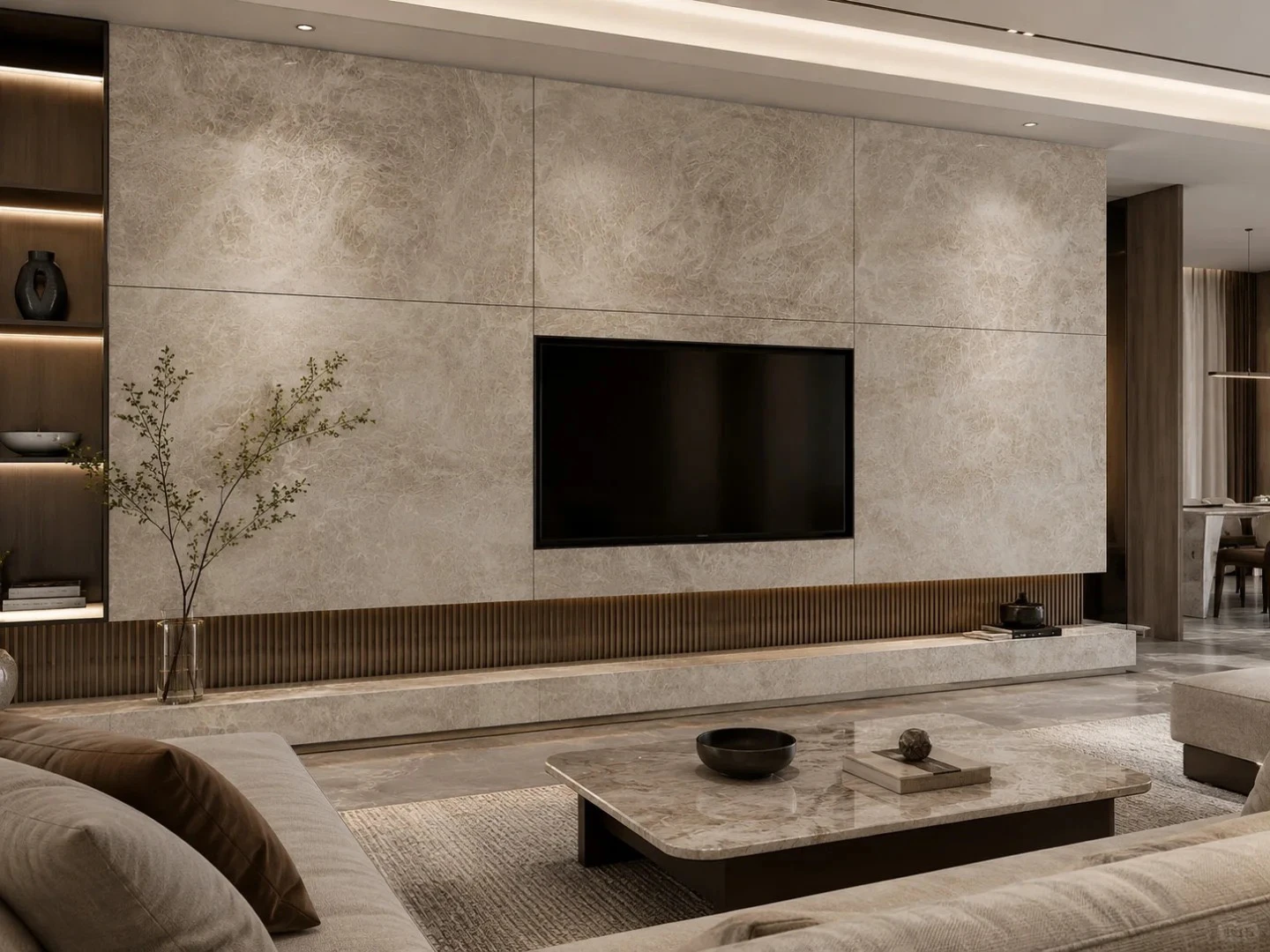
Full-height wall plus floating console is the modern classic: TV mounted flush, console in white oak or matte black, cables hidden in a channel. Stone, screen, console — nothing else.
TV wall plus linear fireplace is the other dominant look. Recess the TV slightly, use a black or brass linear burner, and let the composition read as one horizontal band. Keep the flame well below the slab and follow the fireplace manufacturer's clearance specs.
What kills it: too many competing materials on one wall; a high-gloss polish behind the screen (glare fights the picture); a heavily patterned slab that swallows the TV. Taj Mahal is the low-contrast stone — use it that way.
Taj Mahal Quartzite Fireplace Surround: Warmth, Literally
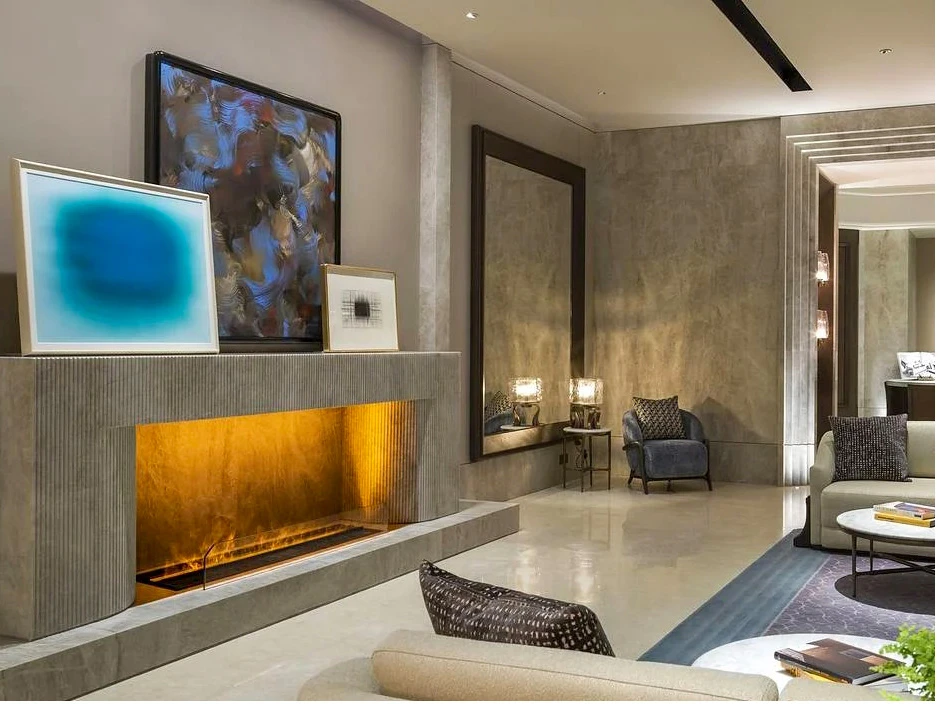
Quartzite tolerates heat far beyond what a hearth produces, so you don't design around the stone — you design with it.
Full cladding (hearth to ceiling) anchors open-plan rooms; a surround-only frame keeps the flame the hero and costs less. Pair the cream stone with a dark slate hearth, blackened steel, or walnut mantel for contrast. On warm-toned floors, choose a honed or leathered finish here — it reads softer and hides ash dust.
Taj Mahal Quartzite Slab Finishes: Polished, Honed, Leathered
The same slab looks like three different stones depending on the finish:
| Finish | Look | Best for | Watch out |
|---|---|---|---|
| Polished | Mirror-gloss, classic | Floors, counters, statement walls | Glare behind TVs; shows fingerprints |
| Honed | Matte, soft, modern | TV walls, fireplace surrounds | Needs sealing discipline |
| Leathered | Textured, warm | Islands, feature walls, high-touch areas | Reads less "marble-like" |
Rule of thumb: polished for floors and counters, honed or leathered for walls.
Colors and Materials That Work With the Slab
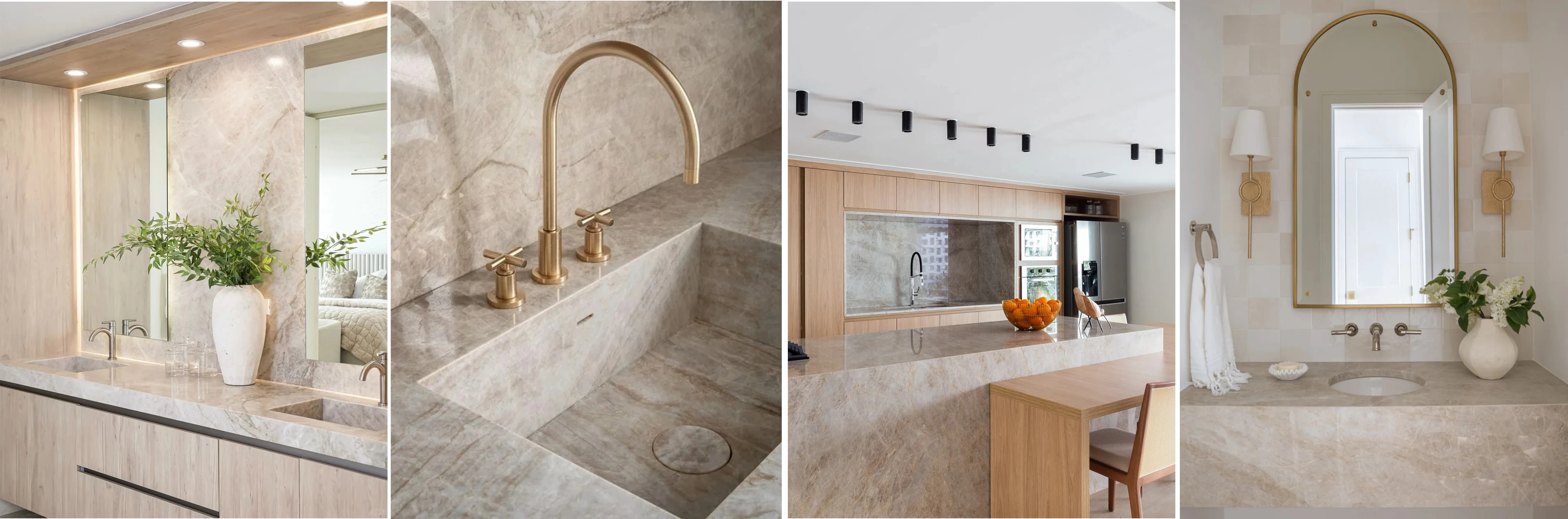
Wood: white oak for light warmth; walnut for contrast. Avoid red-toned woods — orange fights the cream.
Hardware: brushed brass and aged bronze pick up the gold in the veining.
Cabinetry: two-tone (white uppers, wood or dark lowers) is the safest win; sage green or dusty blue is the pairing designers keep returning to; espresso or matte black makes the cream the star.
Textiles: bouclé, linen, rattan, leather — this stone wants natural materials around it, not more gloss.
How to Buy a Taj Mahal Quartzite Slab Without Getting Burned
Buy the pair, not the slab. Bookmatched pairs must come from the same bundle; natural stone doesn't restock.
Verify it's actually quartzite. Some slabs sold under the name are softer dolomitic lookalikes that etch. Ask for the technical sheet: hardness around 6.5–7 Mohs, water absorption below 0.5% (ASTM C97 or equivalent).
Confirm format, finish, and packing in writing — dimensions, thickness, surface, cut-to-size, export packing. These are the details that get disputed later.
Buy sighted, even from far away. Ask for current bundle photos and video in natural light, the bundle number, and exact slab dimensions before committing. Reputable exporters answer these questions gladly.
Caring for a Taj Mahal Quartzite Slab: Less Work Than You Think
Seal after installation, then reseal every one to two years. Test with a water drop — if it darkens the stone after 10–15 minutes, it's time. Daily cleaning is warm water and a pH-neutral stone cleaner. Avoid vinegar, lemon-based cleaners, and bleach — not because the stone is acid-sensitive, but because the sealer isn't. Wipe wine and coffee promptly; use trivets for hot cookware.
FAQ
Is Taj Mahal quartzite real quartzite?
Yes — natural Brazilian quartzite at 6.5–7 Mohs. But verify the specs; some slabs under the name are softer lookalikes.
Can I use it on floors and walls?
Yes — floors, feature walls, TV walls, fireplace surrounds, stairs, backsplashes. 30mm for floors, 20mm for walls and counters.
Can I buy it internationally?
Yes — slabs and cut-to-size pieces ship worldwide. Request bundle photos, the technical sheet, exact dimensions, and confirm export packing in writing.
The Short Version
A Taj Mahal Quartzite Slab is not the loudest choice — and that's the point. On a feature wall, behind the television, or around the fireplace, it makes a room feel considered, warm, and quietly expensive, then gets out of the way. Buy the pair, check the specs, choose the finish by location, and you'll still love the wall in ten years.
Colors and veining vary naturally from slab to slab; photography may not reproduce the exact tone of every bundle.
Planning a project with Taj Mahal quartzite? Send us a message with your application — walls, floors, or counters — and we'll share current bundle photos and the technical sheet. No pitch, just the stone.